

Why Child, Adolescent, and Youth Development Is Central to Bangladesh’s Sustainable Future
A Perspective from Northern Bangladesh
Abstract
Bangladesh’s sustainable development is closely linked to how effectively it nurtures its children, adolescents, and youth. The country’s large young population presents both opportunity and risk, particularly in Northern Bangladesh, where structural poverty, climate vulnerability, and limited access to services hinder human development. This article adopts a life-cycle and intergenerational perspective to examine how early childhood deprivation, adolescent transitions, and youth labor market exclusion are interconnected and mutually reinforcing. Drawing on evidence from districts of Rangpur Division, especially Nilphamari, Rangpur, Lalmonirhat, Gaibandha and Kurigram, it highlights how poverty, unequal educational access, and socio-cultural constraints shape development trajectories. The analysis argues that fragmented, age-specific interventions are insufficient; instead, integrated investments across health, education, protection, and skills development are essential to break intergenerational cycles of disadvantage. A coordinated, regionally targeted, and youth-inclusive approach is critical for achieving Bangladesh’s long-term human development, social resilience, and sustainable future.
Introduction
Bangladesh’s progress toward sustainable and inclusive development is fundamentally shaped by how it invests in its children, adolescents, and youth. With nearly 45% of the population under the age of 25, the country is at a demographic crossroads where human capital investments can yield significant social and economic returns (Bangladesh Bureau of Statistics [BBS], 2023). Northern Bangladesh—particularly districts such as Nilphamari, Rangpur, Lalmonirhat, Gaibandha and Kurigram—faces structural poverty, climate vulnerability, and limited access to quality services, making targeted investments in young populations critical. Since 2010, poverty has risen in Rangpur division, the historically poorer Northwest of the country. (World Bank, 2019).
This article examines why nurturing children, adolescents, and youth across the life course is central to Bangladesh’s sustainable future. Adopting a life-cycle and intergenerational perspective, it argues that integrated, coordinated interventions are essential to build human capital, break intergenerational poverty cycles, and strengthen social resilience in Northern Bangladesh.
Northern Bangladesh: Structural Vulnerabilities
Despite national progress in poverty reduction, Northern Bangladesh remains one of the country’s most socio-economically disadvantaged regions. Poverty rates in Rangpur Division (24.8%) remain above the national average (18.7%), with Kurigram and Nilphamari among the poorest districts (BBS, 2022). Seasonal unemployment (monga), limited educational infrastructure, and constrained access to health services exacerbate childhood and adolescent vulnerabilities.
Climate change further compounds these challenges. Flooding along the Teesta and Brahmaputra river basins frequently displaces communities in Rangpur, Gaibandha, Kurigram Lalmonirhat, and Nilphamari, disrupting schooling and access to health services. In the more densely populated upazilas of northern Rangpur Division, high poverty rates coincide with large populations exposed to heatwaves annually. The most frequent and intense droughts occur in the northwestern districts of Rangpur and Rajshahi Divisions, where over 30% of cropland experiences drought stress at least once every four years. Rangpur Division falls into the highest exposure decile for three or even four natural hazards (World Bank Group, 2022). These intersecting vulnerabilities reinforce intergenerational cycles of disadvantage, affecting children, adolescents, and youth during critical developmental stages.
Bangladesh’s demographic profile offers both an opportunity and a risk. Often described as experiencing a “demographic dividend,” the country has a large working-age population that, if properly educated, skilled, and healthy, can accelerate economic growth and social transformation. However, failure to invest in human development—especially during early and transitional life stages—can turn this dividend into a demographic burden.
In Northern Bangladesh, districts such as Kurigram, Nilphamari, Lalmonirhat, Gaibandha, Rangpur, and also Panchagarh face compounded challenges. Higher poverty rates, malnutrition, school dropout, early marriage, child labor, and youth unemployment remain persistent concerns. These challenges underscore the need for integrated, life-cycle–based approaches to development.
Children: Building the Foundation for Human Capital
Early childhood and middle childhood are pivotal for cognitive, physical, and socio-emotional development. Evidence demonstrates that investments in nutrition, health, early learning, and protection yield the highest long-term social and economic returns (Heckman, 2017; Shonkoff et al., 2012).
In Northern Bangladesh, children experience higher rates of stunting and learning poverty compared to national averages (BDHS, 2022). In many areas of Rangpur Division, seasonal food insecurity undermines children’s growth and cognitive outcomes. While primary school enrollment has increased, classroom overcrowding, teacher shortages, and poverty-related absenteeism continue to reduce learning outcomes (World Bank, 2018).
Integrated interventions addressing nutrition, early learning, health services, and social protection are therefore essential for ensuring that children enter adolescence with strong foundations for success.
Adolescents: Navigating a Critical Transition
Adolescence is a transitional stage where early gains can either be consolidated or lost. Adolescents—particularly girls—face heightened vulnerability to early marriage, school dropout, and limited access to life-skills and reproductive health education.
Northern districts reflect these vulnerabilities acutely. Child marriage rates are notably high in Rangpur division compared to national average, driven by poverty, social norms, and limited secondary education access (MoWCA, 2021; BDHS, 2022). Adolescents who leave school early are more likely to enter low-paid informal employment or early marriage, perpetuating cycles of disadvantage.
Targeted investments in education, digital literacy, leadership, and reproductive health for adolescents have demonstrated effectiveness in delaying marriage, improving school retention, and strengthening agency. Supporting adolescents through these transitions is critical for long-term development outcomes.
Youth: Unlocking Economic and Civic Potential
Youth represent Bangladesh’s largest potential force for economic transformation and social change. Yet youth unemployment and underemployment remain significant, particularly in rural and northern regions. According to a report by the Bangladesh Bureau of Statistics (BBS) Labour Force Survey 2023, 7.2% of the country’s 26.76 million young labor force aged 15 to 29 years are unemployed, accounting for approximately 1.94 million individuals. Rates are more than double the national average, compounded by skills mismatch and limited market access. There is a paradox. We cannot meet job market demand because of a serious skills mismatch. That’s why local employers continue to hire skilled manpower from abroad. In a paradox almost unique to Bangladesh, unemployment is lowest among those with no education (1.25%) and highest among those with university degrees (13.54%). One in every three unemployed Bangladeshis today is a graduate. That is nearly 900,000 jobless degree-holders – double the number just eight years ago. (The Business Standards, 2025)
In districts like Nilphamari, Lalmonirhat, Gaibandha, Kurigram and other district of Rangpur divion, youth depend on low-productivity agriculture or informal employment, often resulting in seasonal or permanent migration. However, Northern Bangladesh holds untapped potential in agro-processing, climate-resilient agriculture, small enterprises, and digital services.
Investments in skills development, entrepreneurship, and youth-led civic engagement can unlock this potential. Beyond economic participation, empowered youth enhance social cohesion, local governance, and disaster resilience—especially in climate-vulnerable regions. For longer-term recovery, disaster victims usually need support through linking social networks, e.g. from the national and international NGOs, local government, and Community-based Organisations. (Islam & Walkerden, 2014).
The Life-Cycle and Intergenerational Perspective
Children, adolescents, and youth are interconnected stages of a developmental continuum. Early disadvantages can compound during adolescence and manifest in youth as unemployment or social exclusion. Conversely, well-coordinated interventions generate cumulative, intergenerational benefits.
A life-cycle approach emphasizes continuity, integration, and multi-sectoral coordination across health, education, protection, skills, and employment. In Northern Bangladesh, where vulnerabilities are intergenerational, this approach maximizes developmental impact and ensures sustainable outcomes. Failing to invest in our youth is a false economy. Conversely, investing in young people will pay great dividends for all. Young people have talents, dynamism, imagination, ideals, considerable energies and vision. They can also be the most affected when a crisis hits. Young people’s open-minded attitude to technology, and their different perspective, vision and motivation can contribute to practical solutions.
Policy and Development Implications
For development partners and policymakers, key priorities include:
- Integrated Life-Cycle Programming: Align interventions for children, adolescents, and youth to ensure continuity and intergenerational impact.
- Regional Targeting: Prioritize high-poverty, climate-vulnerable districts such as Kurigram, Lalmonirhat, Nilphamari, Gaibandha, and Rangpur.
- Systems Strengthening: Invest in local government, education, and health systems for sustainable service delivery.
- Youth Engagement: Recognize youth as active participants in program design and governance. Engage young people as co-creators and leaders, not only beneficiaries.
- Sustained Investment and Long-Term Commitment: Long-term, predictable investments are essential for meaningful human development outcomes. Human development outcomes require sustained, predictable investment beyond short project cycles.
In the next 10 years, we need to strengthen government and civil society commitment and move to mainstreaming youth issues across all areas and sectors. We should seek to expand good practices, making the innovative concept.
Conclusion
Investing in children, adolescents, and youth is central to Bangladesh’s sustainable development. Northern Bangladesh, with its structural vulnerabilities and climate exposure, exemplifies both the challenges and opportunities of this investment.
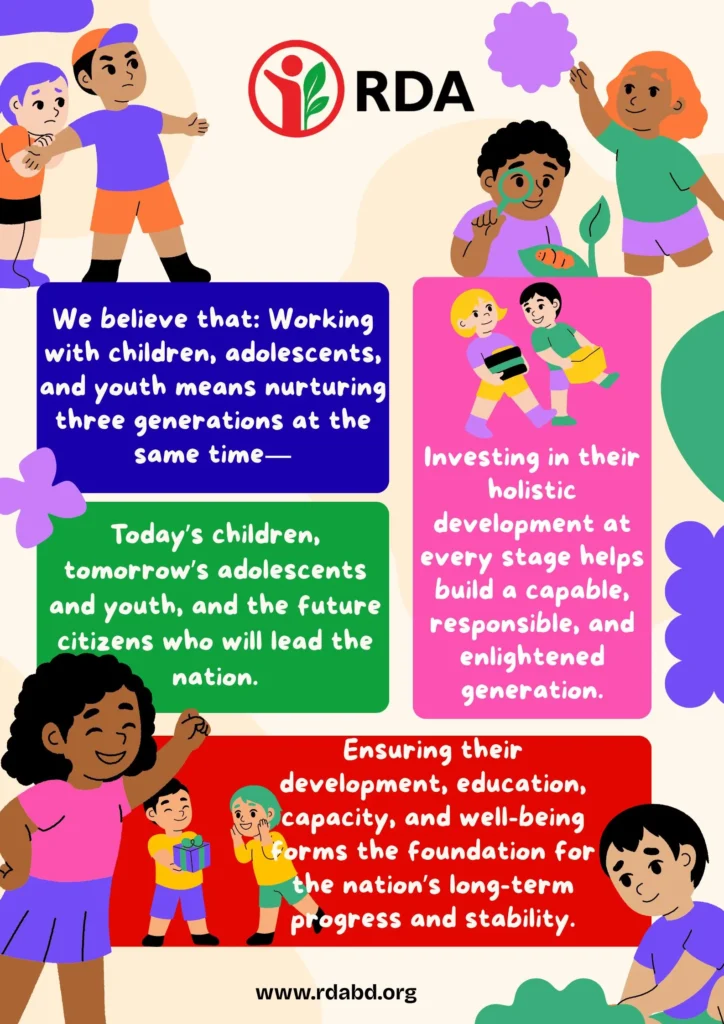
A life-cycle, intergenerational approach—coordinated, regionally targeted, and youth-inclusive—can break cycles of disadvantage, strengthen human capital, and secure the nation’s long-term social and economic resilience. Three generations nurtured today lay the foundation for a sustainable tomorrow.
References:
Bangladesh Bureau of Statistics (BSS). (HIES 2022). Household income and expenditure survey 2022. Statistics and Informatics Division, Ministry of Planning.
Heckman, James J. (2017). Giving kids a fair chance. The MIT Press.
Islam, Rabiul & Walkerden, Greg. (2014). How bonding and bridging networks contribute to disaster resilience and recovery on the Bangladeshi coast. International Journal of Disaster Risk Reduction 10 (2014) 281-291.
Ministry of Women and Children Affairs. (2021). National Action Plan to End Child Marriage 2018–2030. Government of Bangladesh.
Shonkoff, Jack P., et al. (2012). The lifelong effects of early childhood adversity and toxic stress. Pediatrics, 129(1), e232–e246. https://doi.org/10.1542/peds.2011-2663
National Institute of Population Research and Training (NIPORT) and ICF. 2024. Bangladesh Demographic and Health Survey 2022: Final Report. Dhaka, Bangladesh, and Rockville, Maryland, USA: NIPORT and ICF.
World Bank. (2018). World Development Report 2018: Learning to Realize Education’s Promise. Washington, DC: World Bank.
World Bank. (2019). Bangladesh Poverty Assessment: Facing old and new frontiers in poverty reduction. World Bank.
The World Bank Group. (2022). Bangladesh Country Climate and Development Report. The World Bank Group.
Rahman, Sajjadur. (2025, 20 September). Degrees of despair: Why university graduates can’t find work. The Business Standards. https://www.tbsnews.net/bangladesh/education/degrees-despair-why-university-graduates-cant-find-work-1240566